Product:
An AI-assisted career guidance platform that turns questionnaire responses from children and parents into personalized reports with career recommendations, educational pathways, and university suggestions.
Delivery:
A web platform with a guided questionnaire, paid plans that determine report depth, and downloadable reports. Organizations have a dedicated dashboard to manage licenses, track usage, and create projects within their available limits.
Devstark role:
We handled full-stack product development, from designing the user journey to building the multi-stage AI pipeline, billing, licensing, and document export.
The context
We developed a digital product for career guidance that turns fragmented responses from a child and their parent into a structured, personalized report. The report includes career recommendations, educational pathways, university suggestions, and a final document that can be reviewed, discussed, and used as a foundation for the next steps.
On the surface, it is a straightforward service with a questionnaire, pricing plans, project statuses, and a completed report.
Underneath, it is a much more complex system. In this system, the frontend manages the user journey, while the backend handles the domain model, AI pipeline, billing, licenses, document export, and operational workflows.
The project’s core value was not simply “connecting AI,” but integrating it into the product workflow in a way that made it useful in practice.
The solution development
Guiding users from questionnaire to report
Challenge:
The first problem to solve was developing a coherent user flow based on a rather complicated logic of the system.
It would not have been enough just to develop a set of APIs and some forms. The user flow had to be smooth, comfortable, and clear.
Solution:
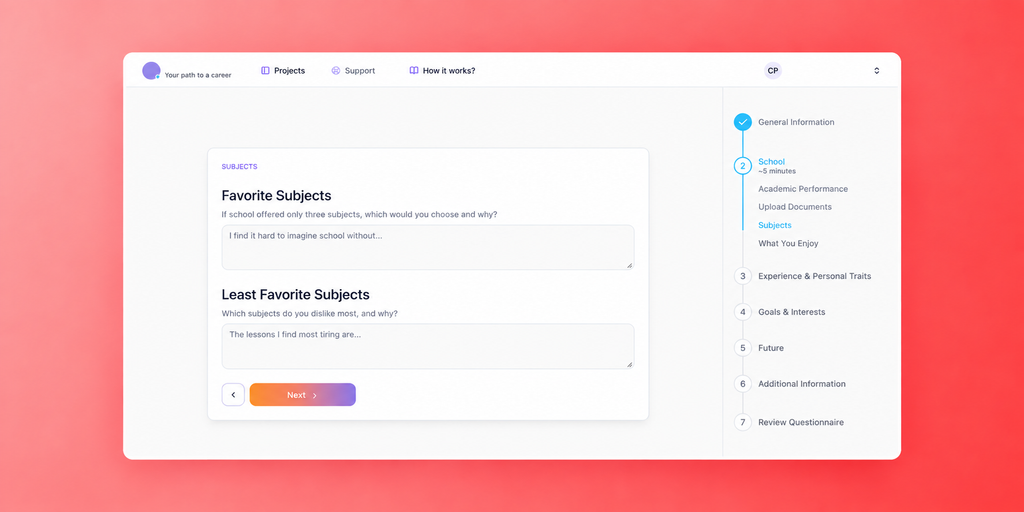
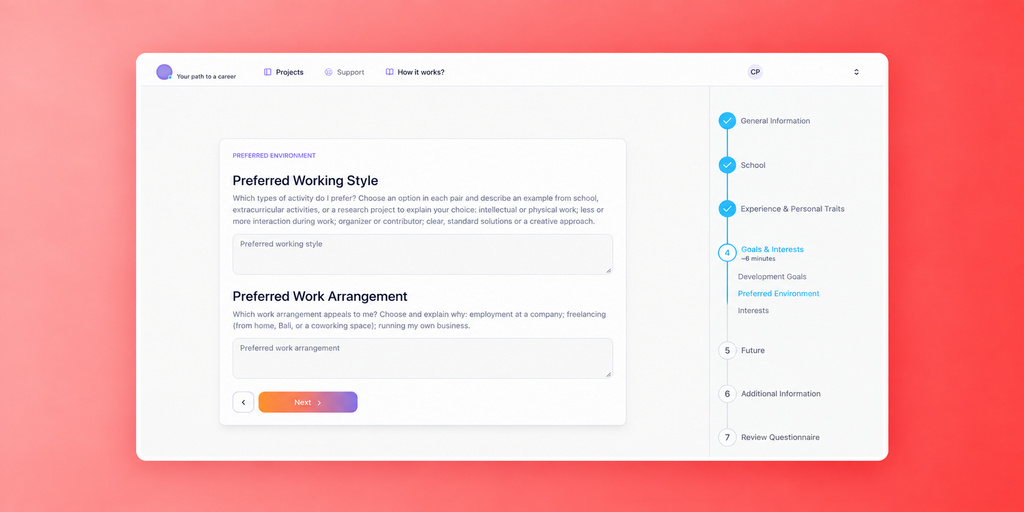
The service begins with an introductory page explaining the product, how to prepare for the questionnaire, and what users will receive. For a service interpreting personal information, trust and clarity matter almost as much as algorithm quality. Setting expectations helps users understand why they should complete the process.
We made the project the system’s central unit, connecting the questionnaire, payment, generation, and final report into one coherent workflow. After the questionnaire is completed, the system determines whether to direct the user to payment, start generation immediately, or move to the next stage. Users choose a clearly defined plan, with pricing linked to the depth and content of the report.
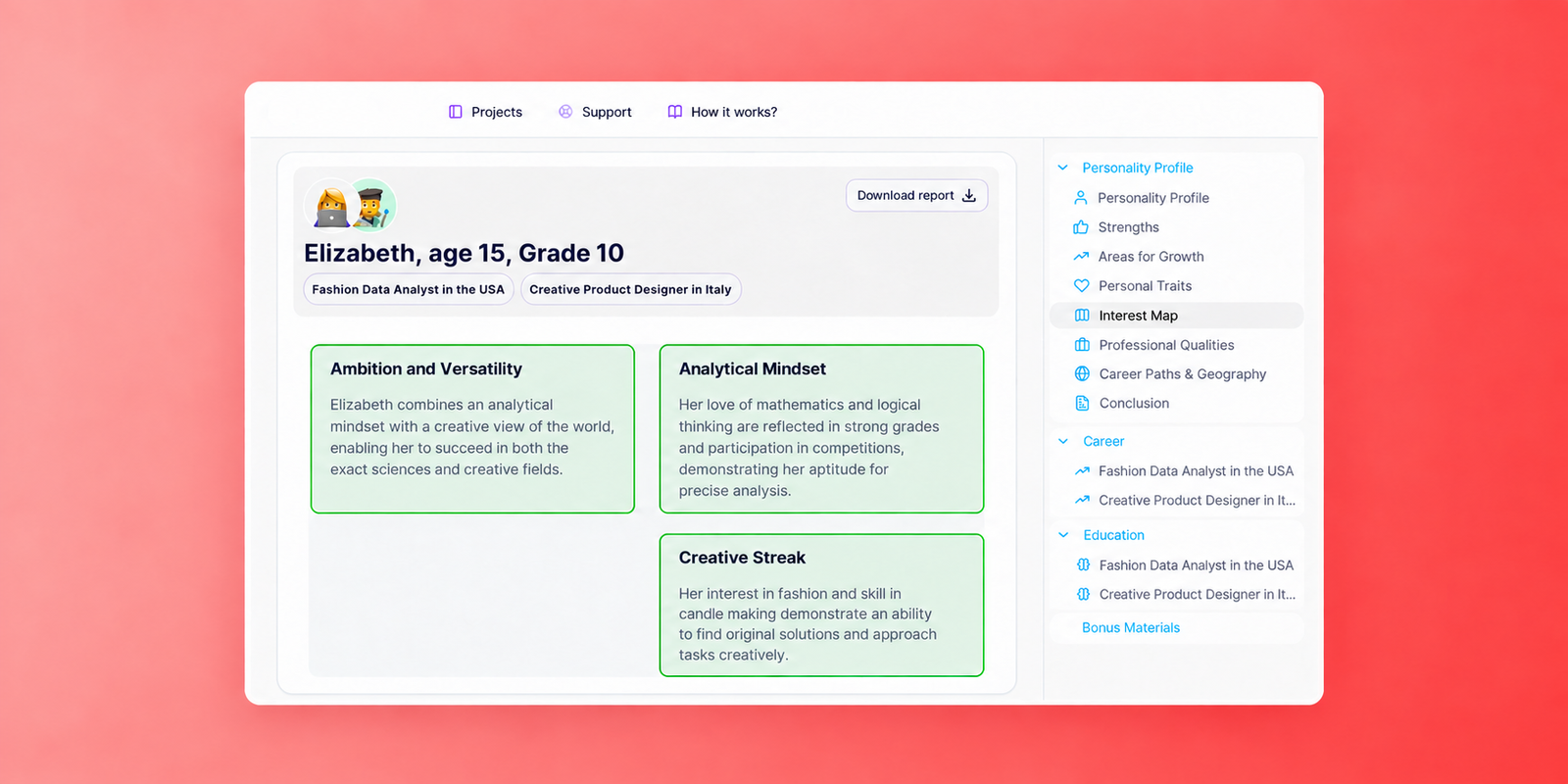
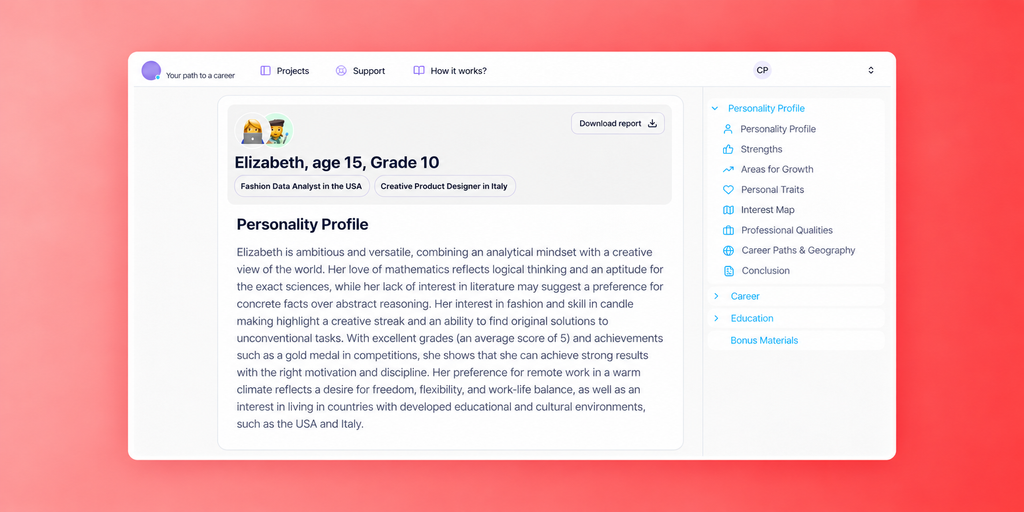
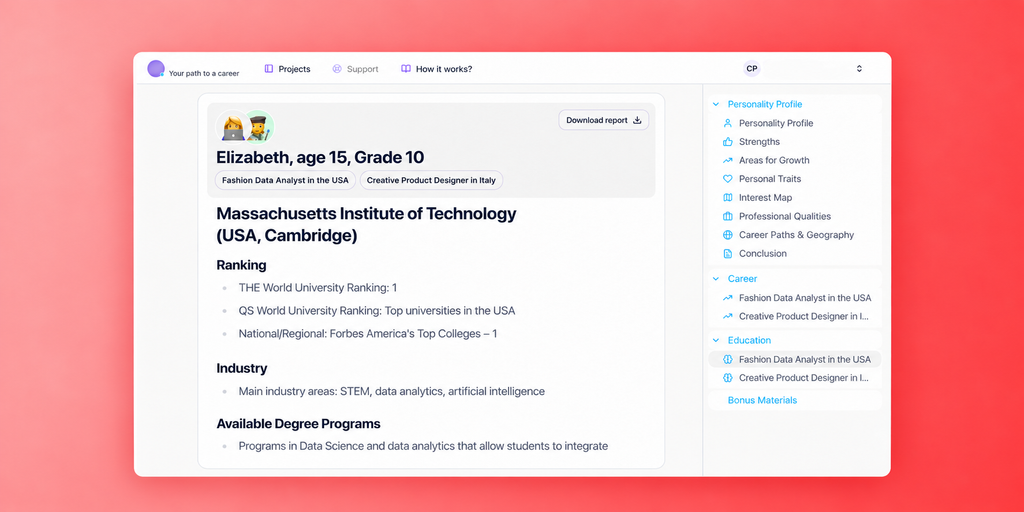
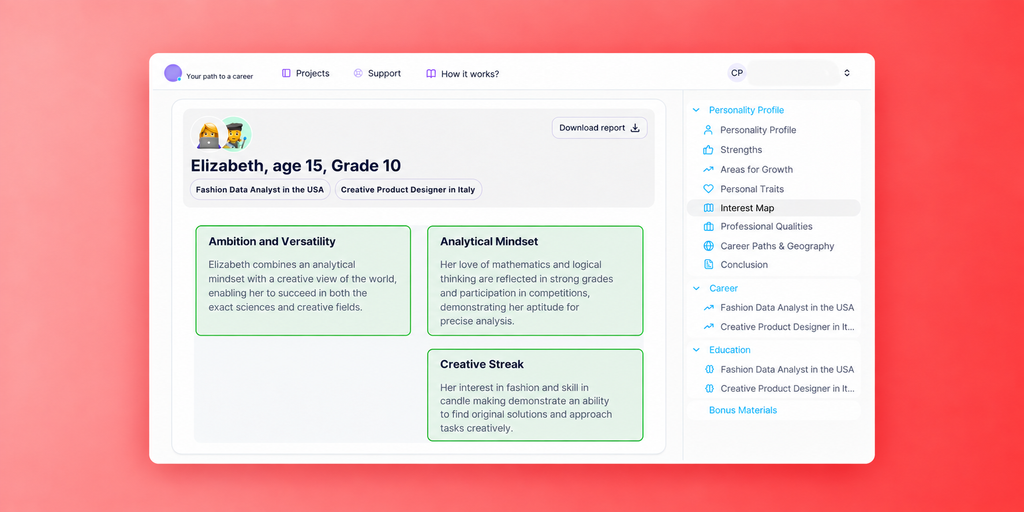
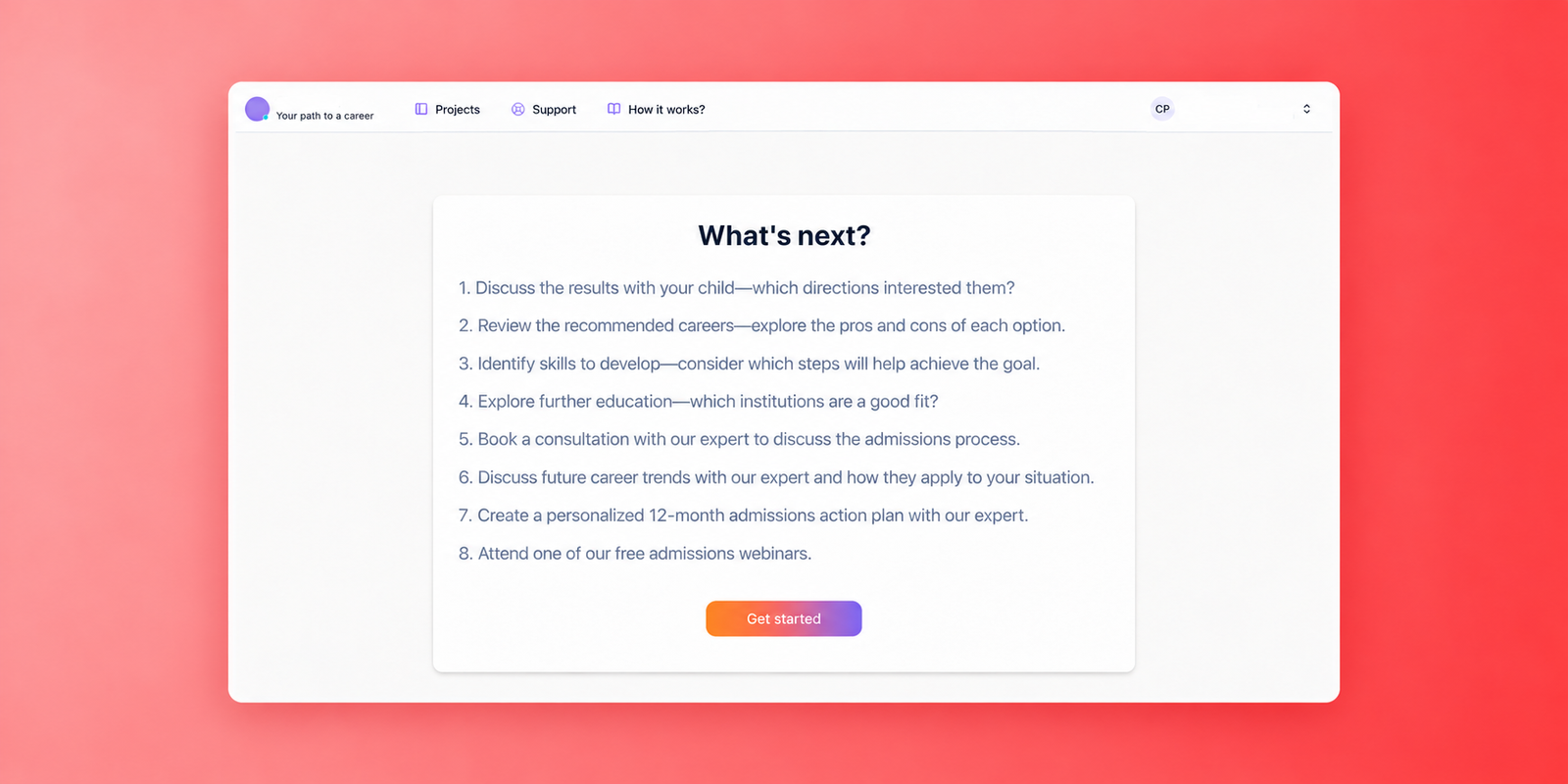
During generation, the system tracks project status and advances the workflow automatically, keeping users informed while they wait. The final report organizes career options, educational pathways, and conclusions into readable sections. Document export turns AI output into a practical deliverable that users can review, discuss, and use to plan their next steps.
Turning varied inputs into structured analysis
Challenge:
The second challenge was handling unstructured user input. The child’s questionnaire, the parent’s perspective, supporting files, and other materials were all very different sources of information.
A single-step generation process would quickly become unreliable. The system was therefore built as a pipeline with multiple stages of analysis.
Solution:
The system does not use a simplified “one large prompt, one large text” approach to report generation. Instead, it breaks the process into several stages.
First, it assembles a unified input context from the child’s responses, the parent’s perspective, additional notes, and supporting materials.
It then runs the core profile analysis, turning this unstructured input into a more coherent and meaningful narrative.
Structured information is extracted from that analysis to support the subsequent stages: analyzing career directions, creating additional report sections, generating visual data, and researching universities and educational opportunities.
Only then are the results assembled into the final report. Although such an approach is more complex, it is better suited to a real product since the inputs are too varied to rely on a single generation step for consistent results.
Dividing the process into stages provides greater control over the quality, structure, and depth of the analysis.
Tying pricing plans to report depth
Challenge:
The third challenge concerned pricing plans. The platform's interface needed to present clear packages, while the system had to deliver meaningful differences in the results.
These demands required connecting the commercial model with the technical depth of the analysis within a single framework.
Solution:
The pricing and payment screen establishes the product as a commercial service. Users choose a plan, accept the terms, and understand exactly what they are purchasing. The selected plan directly affects the depth and content of the final report.
Pricing is therefore an integral part of the system’s business logic. The frontend presents the available packages. The backend, in its part, determines the depth of analysis and the result the user receives based on their selection.
Managing organizational licenses and usage
Challenge:
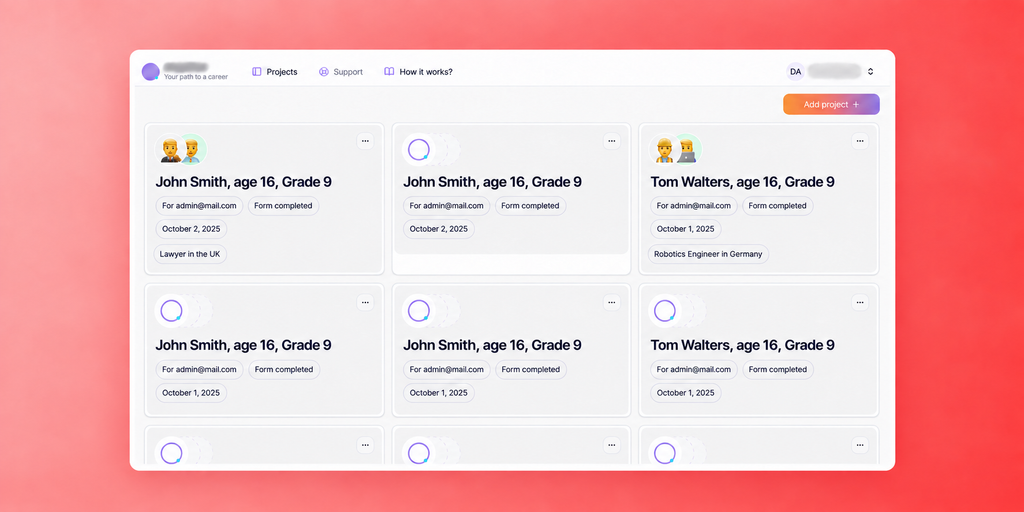
The fourth challenge was B2B licensing. On the surface, the interface looks simple: a list of packages, remaining balances, and a button to create a project. Underneath, however, it involves managing licenses, tracking the history of changes, and handling concurrent operations. The above-mentioned flow required more rigorous logic than a typical B2C flow.
Solution:
Here, we've implemented license-limited project creation with balance tracking and transaction history, supported by a distinct organizational workflow. The backend separately manages the licensing and organizational workflows, including preserving business rules when license operations occur concurrently.
Separating AI interpretation from factual research
Challenge:
The fifth challenge was the quality of AI output. For a product like this, a model that simply “writes well sometimes” is not enough.
Considerations about quality criteria, observability, wording checks, and consistent results needed to be made. Especially when a product interprets personal data and provides individualized recommendations.
Solution:
We divided the process into stages to provide greater control over the quality, structure, and depth of the analysis.
We also separated generation tasks from research tasks, using different mechanisms for profile interpretation and narrative generation than for research sections requiring factual accuracy, links, and sources.
Connecting the user journey and backend operations
Challenge:
The sixth challenge was rethinking the product as a complete full-stack system. Both the interface and the backend quickly outgrew their original boilerplate foundations. The project therefore needed to be reimagined as a platform with an integrated product and operational framework, rather than simply a collection of technologies.
Solution:
One of the most successful decisions was to design the frontend and backend as parts of one system while keeping their responsibilities separate. The decision to do so allowed the frontend to develop as the product and UX layer, and the backend as an independent domain platform with its own logic, statuses, roles, and AI processes.
The second key decision was to make the user-created project the central unit of the entire system. This brought all user actions, statuses, and transitions together around one clear entity.
The backend was built as an administrative and application platform that manages data, roles, projects, billing, licenses, and AI processing. Document generation was placed in a separate layer so that the final export would remain separate from the core report-building logic.
The project’s most important achievement is that it combines a strong product UX with complex internal logic without making them feel like two separate worlds. For users, it appears as a convenient, straightforward service. Underneath, it is a complete platform capable of managing projects, statuses, pricing plans, licenses, and substantive report generation.
What we delivered
We delivered a complete AI-powered career guidance platform, connecting a clear user journey with staged analysis, paid service tiers, and B2B licensing.
For individuals, the platform brings questionnaire completion, payment, generation tracking, and report reading into one guided workflow. The final deliverable combines personalized career recommendations, educational pathways, university suggestions, and visual summaries in a structured, downloadable report.
For organizations, a dedicated dashboard supports license management, package balances, transaction histories, and project creation within available limits. Pricing plans determine the depth and content of the analysis, connecting the commercial offer directly to the service delivered.
The result is a unified product in which the interface, AI pipeline, billing, licensing, and document export work together to support the full service lifecycle.
Technologies and their roles
- Next.js: customer journey, project screens, and report interface.
- Payload CMS and PostgreSQL: application records, administration, and service rules.
- OpenAI API: AI processing within the staged report workflow.
- TanStack Query: interface data fetching and synchronization.
- Tailwind CSS and Radix UI: styling and interface components.



















.svg)