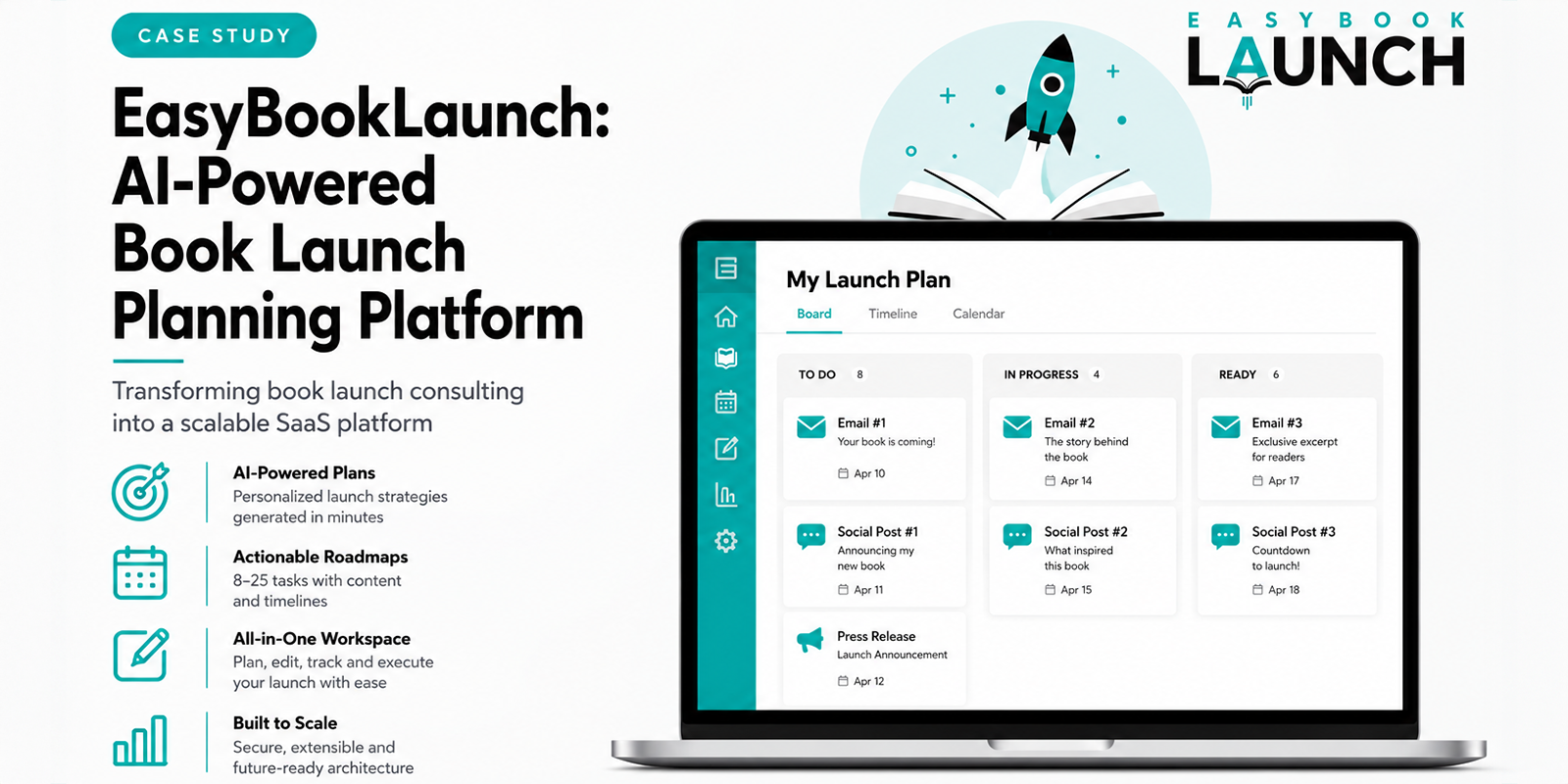
The context
EasyBookLaunch started with a business problem rather than a technology problem.
The client had built a successful consulting service helping independent authors launch their books. Every engagement involved creating marketing timelines, writing promotional content, planning email sequences, and guiding authors through the launch process manually.
The expertise worked very well. The business model, however, did not scale.
Each new customer required significant one-on-one involvement, making growth difficult. The long-term vision was to package years of launch experience into a self-service platform that could deliver the same value without requiring manual consulting.
The target audience consisted primarily of independent authors and self-publishers who don't have dedicated marketing teams. While they know their books extremely well, many struggle with common book marketing questions like:
What should happen before launch?
When should promotion begin?
Which emails should be sent?
How many social posts are needed?
What activities actually drive sales?
The challenge wasn't creating another AI text generator, as plenty of those already exist.
The challenge was translating domain expertise into software.
The Devstark team helped our client develop EasyBookLaunch, an AI-powered platform that turns information about a book into a complete marketing campaign. Authors receive a personalized launch roadmap, pre-written content assets, and a task board that guides them through the entire launch process.
Instead of producing isolated pieces of content, the platform delivers an operational workflow.
The challenge
Several technical and business problems had to be solved simultaneously.
Manual consulting was difficult to scale. Every launch campaign required significant human involvement, limiting growth.
Authors lacked structure. Most customers understood their books but had no repeatable framework for marketing them.
Existing AI tools generated content, not processes. Generic AI products could write emails or social posts, but they could not organize those assets into a coherent campaign.
AI outputs needed to be reliable. Free-form LLM responses are difficult to use directly inside applications. The platform required predictable outputs that could drive UI components and workflows.
Monetization and generation had to work together. Subscription plans needed to control not only access but also influence the quality and scope of generated campaigns.
The result had to feel simple for authors while hiding substantial complexity behind the scenes.
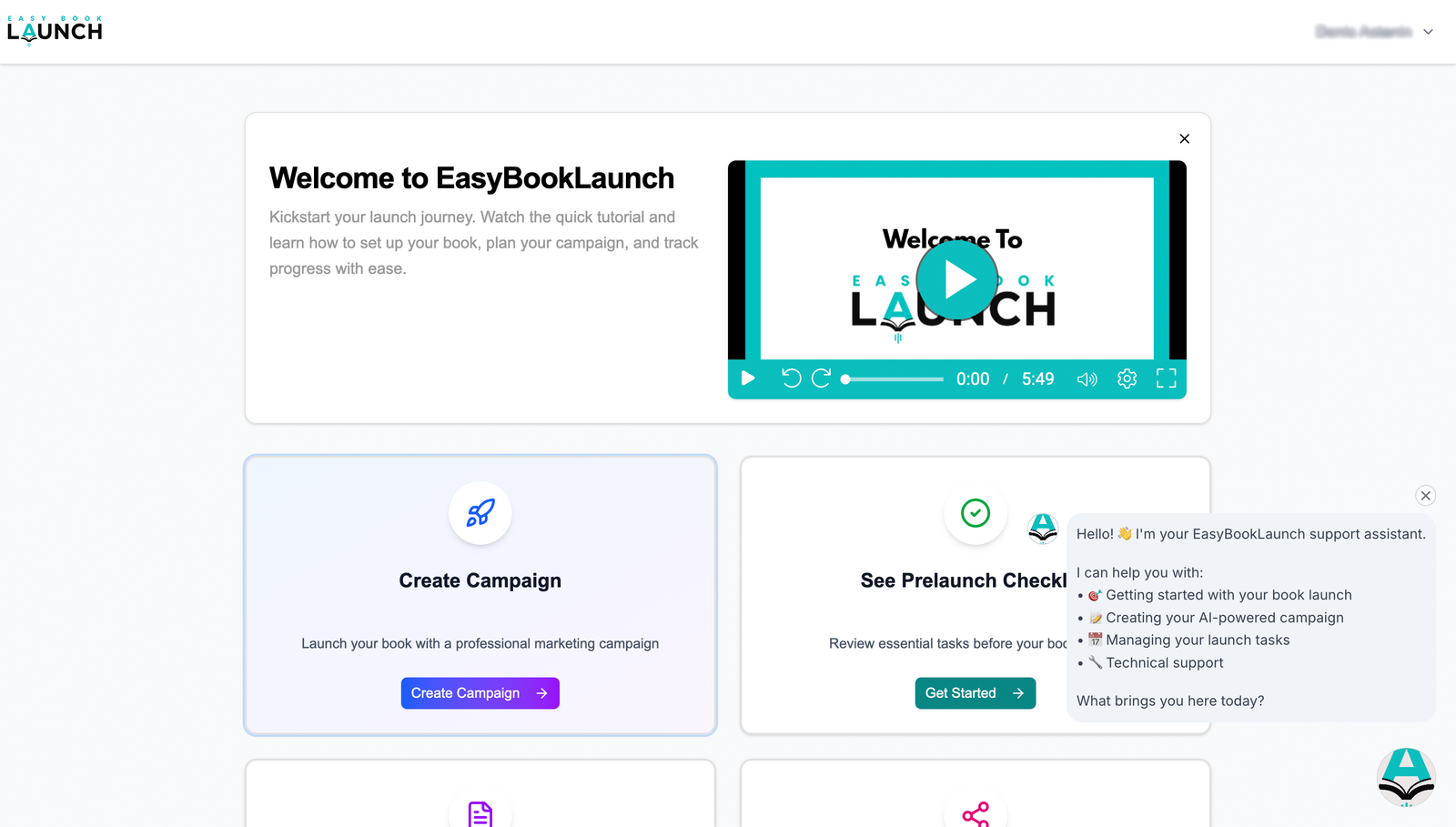
The solution development
EasyBookLaunch was built as a modern SaaS application with scalability in mind.
The initial platform included:
user registration and authentication;
subscription management through Stripe;
author and book profiles;
campaign entities;
secure data storage;
editable launch settings.
The architecture was intentionally designed to support future capabilities such as:
email marketing integrations;
Canva integrations;
analytics;
publisher accounts;
tiered pricing;
multi-author workflows.
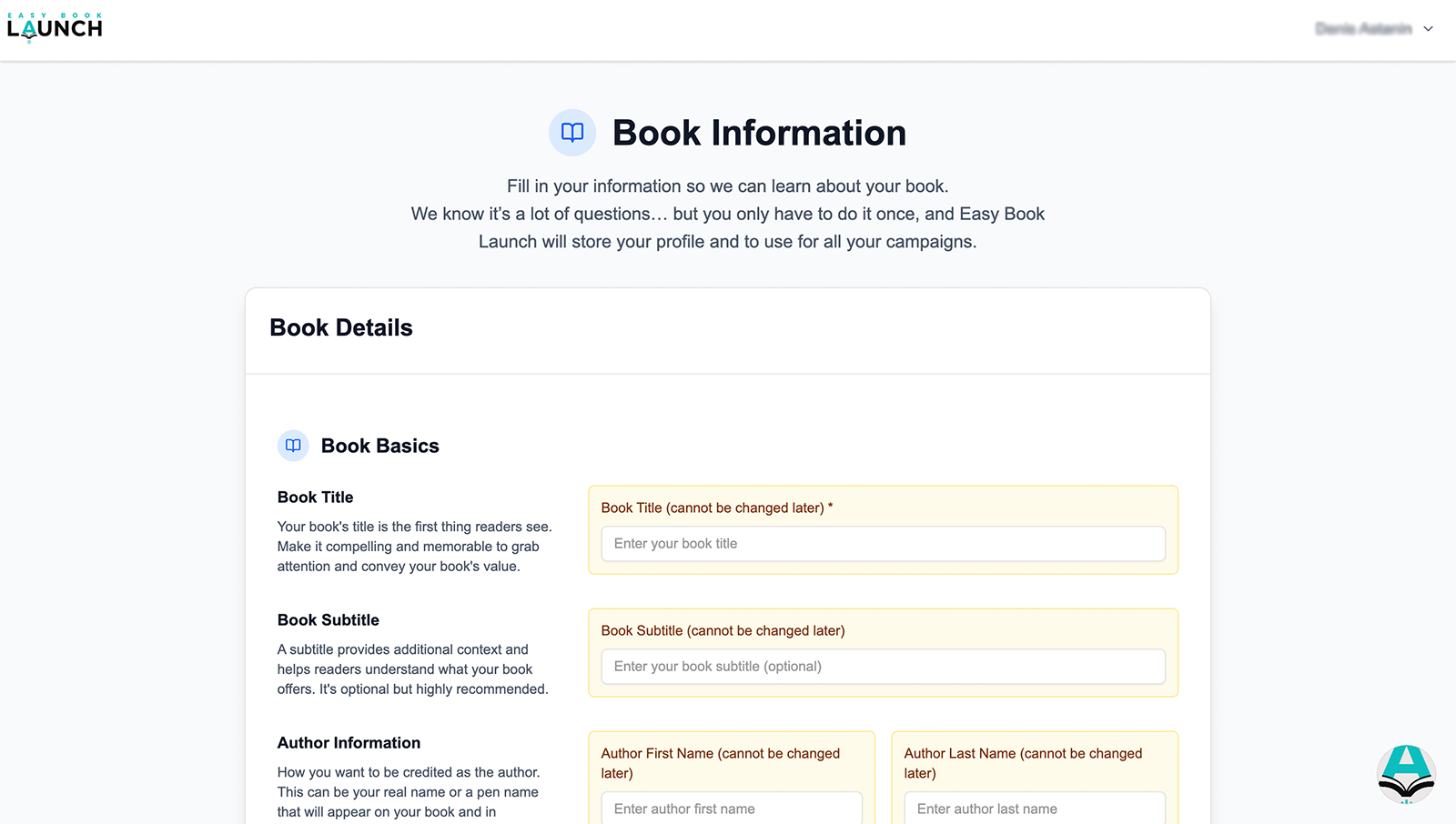
One of the main architectural decisions was placing Campaigns at the center of the system.
Instead of attaching subscriptions directly to users and generated assets directly to books, the platform introduces Campaigns as a domain entity that connects authors, books, subscriptions, launch settings, and AI-generated tasks.
Campaigns operate through a state machine:
Draft → Generating → Active → Archived
This approach simplifies reasoning about system behavior and prevents inconsistent states.
For example:
successful Stripe payments activate campaigns;
campaign generation moves status to Generating;
successful AI execution transitions campaigns to Active;
failures safely return campaigns to Draft.
From the user's perspective this whole process appears as a single "Activate Book" button. Internally, multiple systems are coordinated behind that action.
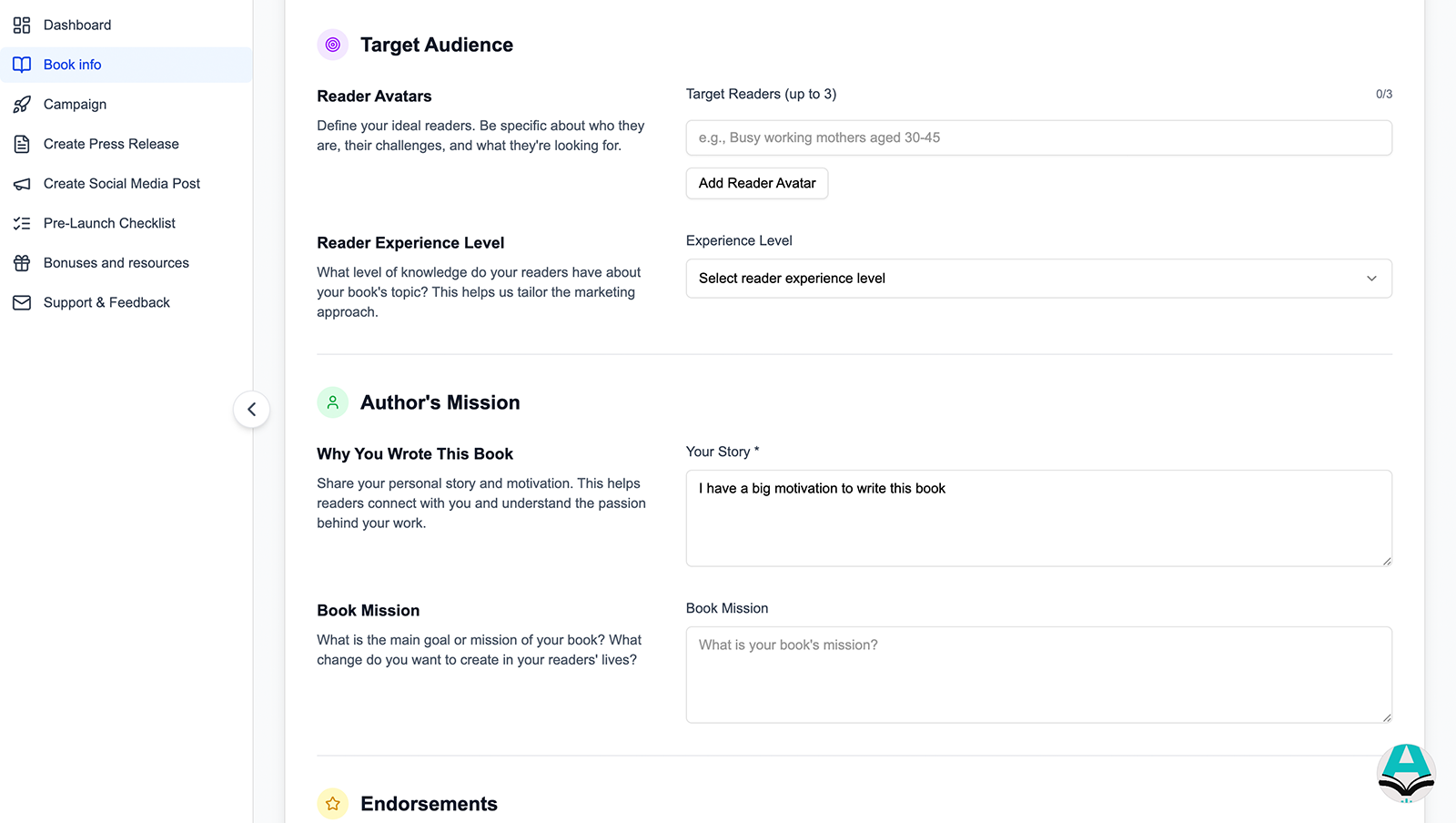
The campaign engine transforms raw author information into a structured launch strategy.
Authors provide information such as book descriptions, target audience information, launch dates, communication tone, and, additionally, possible bonuses and promotions.
The platform supports multiple launch templates and campaign configurations.
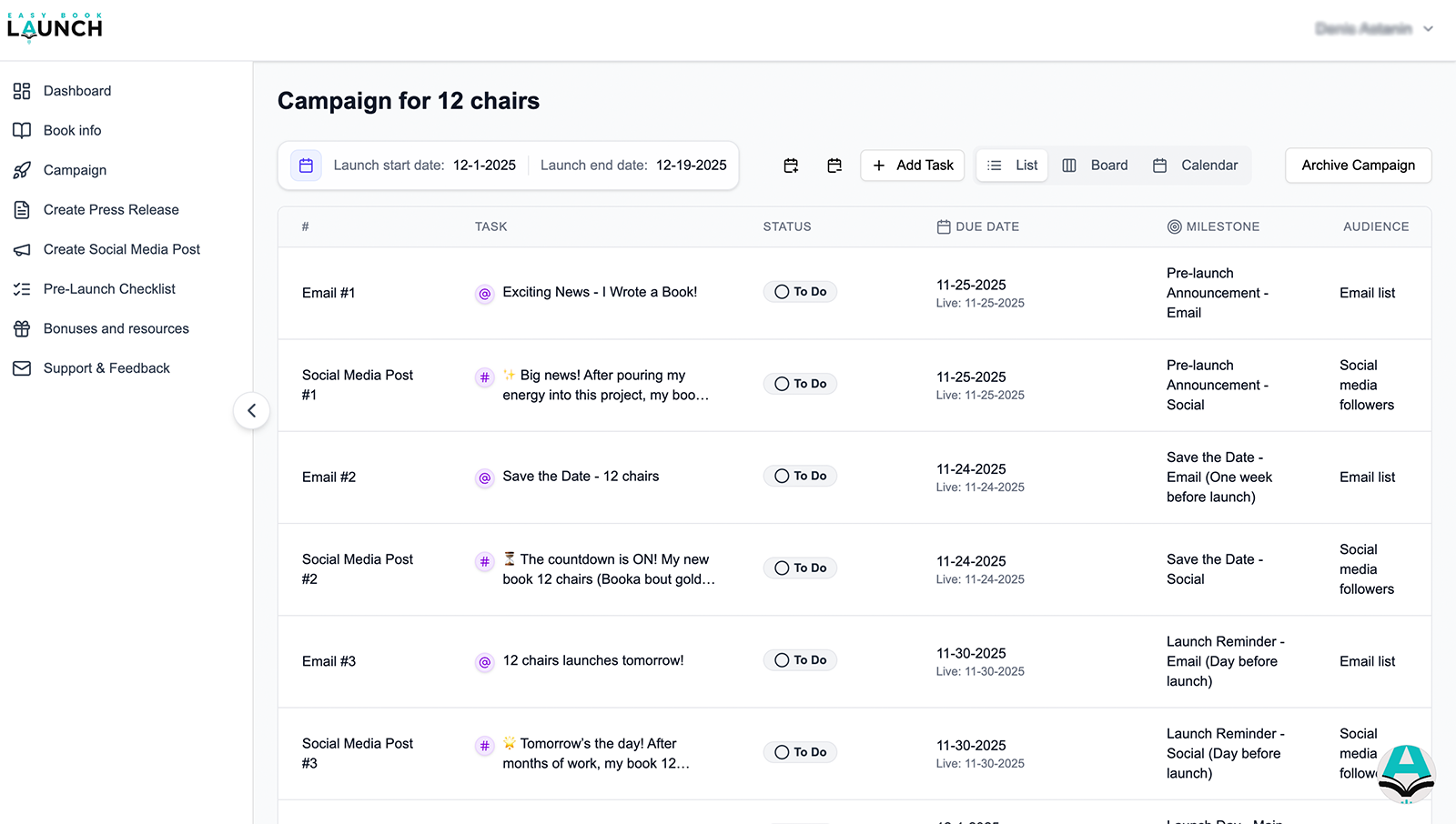
Using this information, the system generates between 8 and 25 tasks per campaign, including email sequences, social media content, launch reminders, and promotional activities.
Instead of receiving generic content, authors receive a chronological roadmap they can immediately put to use.
A major engineering challenge was turning probabilistic AI outputs into deterministic product behavior.
Rather than relying on one large prompt, generation was divided into stages:
- Context collection where book data, campaign settings, and subscription information are gathered.
- Context normalization - arrays, metadata, reviews, and optional fields are converted into a format optimized for LLM consumption.
- Preventing hallucinations - one of the biggest challenges in content generation is dealing with incomplete input. Authors frequently leave sections such as testimonials, awards, audience information, social links, and promotional details blank. Instead of allowing the model to invent missing information, the platform intentionally inserts human-readable placeholders. Missing information is intentionally represented through placeholders rather than allowing hallucinated facts.
- Prompt composition - base instructions are enriched with campaign-specific and subscription-specific guidance.
- Structured output generation - OpenAI responses are validated using Zod schemas, forcing the model to return predictable objects instead of arbitrary text.
- Post-processing - Business rules assign task numbering, statuses, and mutually exclusive content types.
- Persistence - generated tasks are stored directly inside campaigns and displayed to users immediately.
This architecture eliminated many traditional parsing problems and made AI outputs reliable enough to become part of the application itself rather than just supplementary content.
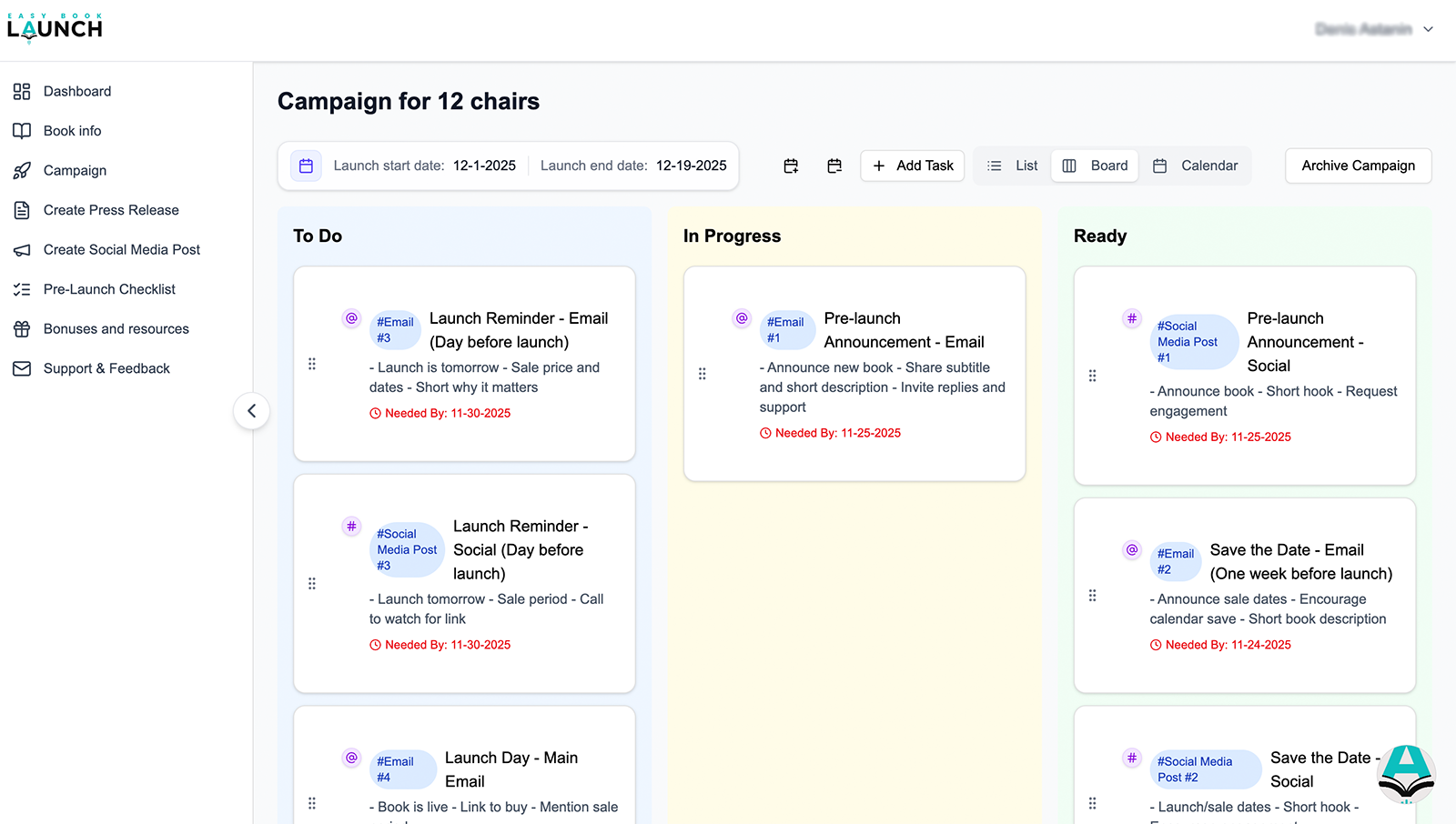
After generation completes, users receive a Kanban-style workspace.
Authors can:
move tasks between stages;
edit content;
track completion;
manage timelines visually.
The platform effectively converts abstract marketing activities into operational tasks.
This shift is important because users do not experience AI as "generated text" — they experience it as work that is already organized and ready to execute.
Additional AI tools were introduced around the same architecture.
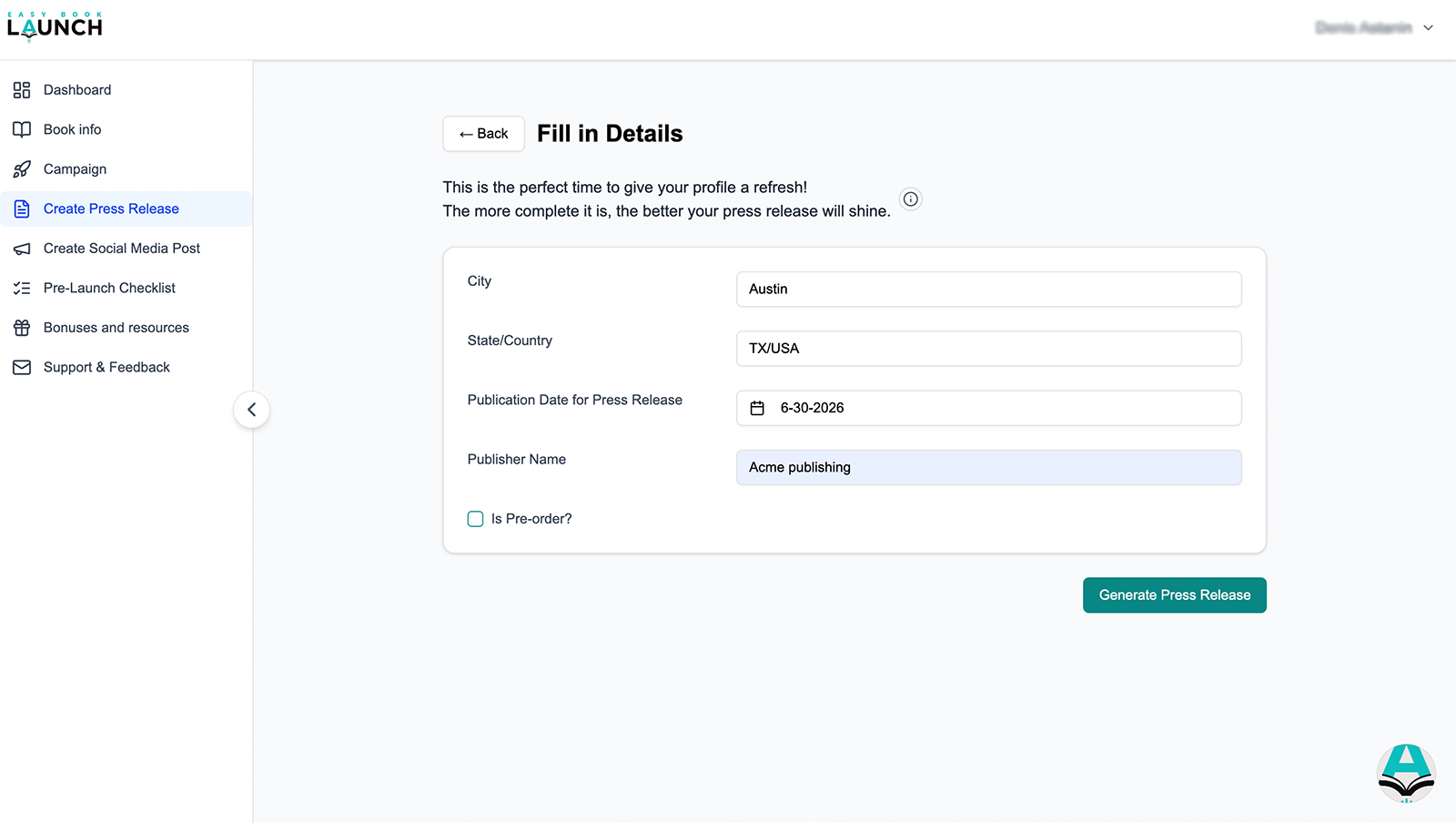
Press Release Generator
Supports multiple scenarios including:
book launches;
milestones;
translations;
new editions;
book tours.
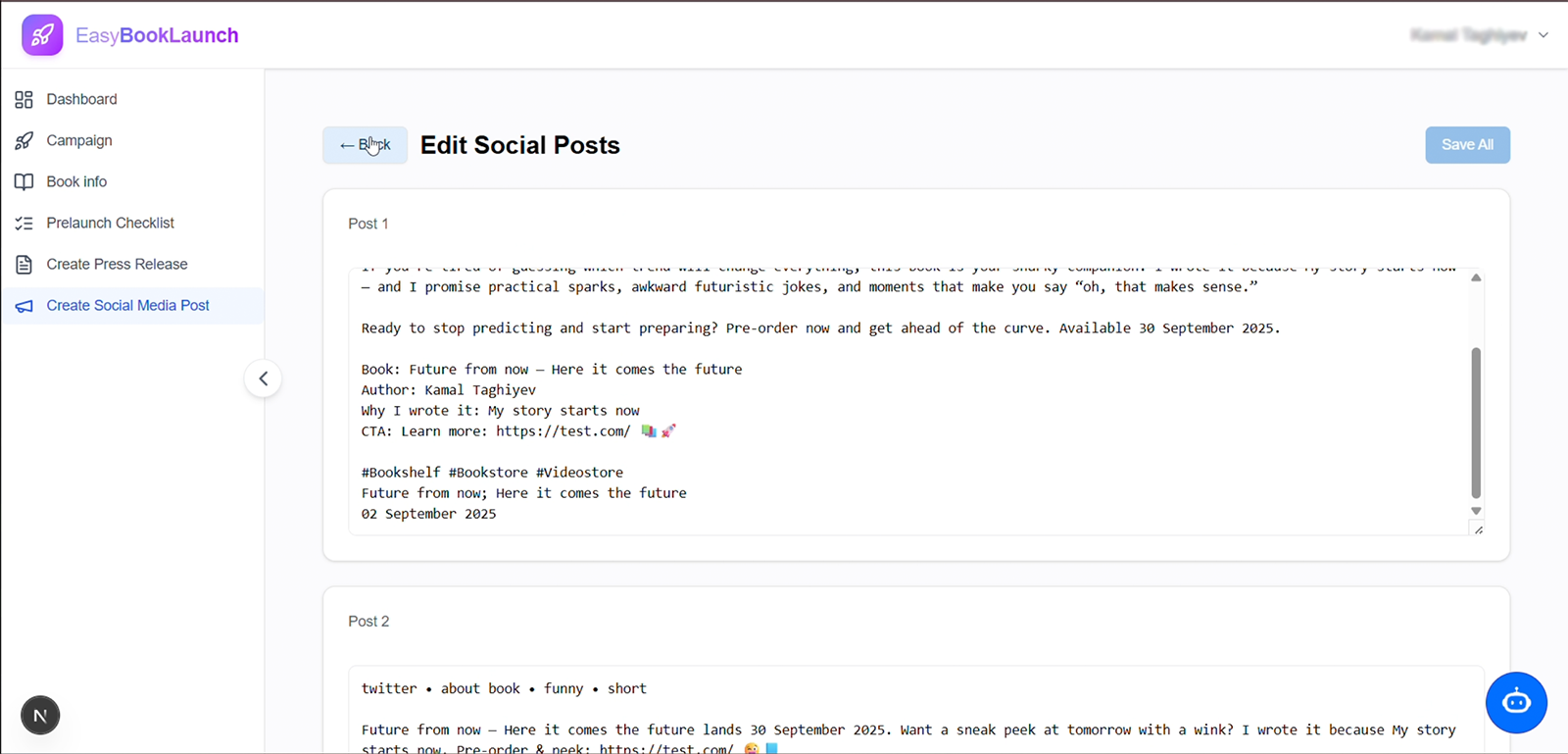
Social Media Generator
Provides ongoing monthly content for audience engagement.
Each subsystem follows the same design philosophy:
dedicated prompts;
schema validation;
deterministic outputs;
domain-specific rules.
This consistency keeps the platform extensible while avoiding prompt chaos.
Results and business impact
EasyBookLaunch successfully transformed a manual consulting business into a scalable software platform.
Authors can now generate complete launch campaigns within minutes rather than relying on custom consulting engagements.
The platform delivers:
Repeatable launch workflows
Authors no longer start from scratch.
Reliable AI outputs
Structured generation ensures consistency and predictability.
Reduced operational complexity
Planning, content creation, and execution are managed inside a single system.
Scalable monetization
Subscription plans influence both access and generated value.
Future-ready architecture
The platform can support:
email integrations;
Canva integrations;
advanced analytics;
publisher dashboards;
agency accounts;
multi-user collaboration.
By combining domain expertise with structured AI architecture, EasyBookLaunch became more than a content generator.
It became an operational system for book launches.
Technologies used:

Next.js
Next.js is a React framework for building full-stack web applications. You use React Components to build user interfaces, and Next.js for additional features and optimizations.

Payload CMS
Payload CMS includes built-in features like role-based access control (RBAC), two-factor authentication (2FA), and detailed audit logs. These features ensure that only authorized users can access and modify content, as well as provide a clear record of all actions within the CMS. Additionally, Payload CMS focuses on protecting data and preventing common vulnerabilities to offer high security to users.

OpenAI
OpenAI provides models like GPT (Generative Pre-trained Transformer), which excels in natural language understanding and generation. These models can be used to build everything from chatbots and content generators to code assistants and data analyzers. OpenAI's API is incredibly versatile, allowing easy integration into web and mobile applications.

TypeScript
TypeScript is an open-source programming language that extends JavaScript by adding static typing. It helps developers catch errors early, improve code quality, and enhance maintainability.TypeScript is compatible with modern JavaScript frameworks like React, Angular, and Vue.js, making it a go-to choice for high-quality software development.

React.js
The library for web and native user interfaces. Whether you work on your own or with thousands of other developers, using React feels the same. It is designed to let you seamlessly combine components written by independent people, teams, and organizations.

PostgreSQL
A powerful, open source object-relational database system with over 30 years of active development that’s earned a strong reputation for reliability, feature robustness, and performance.






.svg)