

Making the right choice in software development
This article will appeal to you if you find yourself at a junction in the digital world and wonder if you should go for an existing piece of software or create one on your own.
Whether you choose to develop your software from scratch or purchase one off the shelf is an important choice that could have implications for your business and budget.
Let us delve into what you need to consider when making this choice between creating and purchasing.
The build option
To "build" implies the process of creating custom software or the development of software from scratch. There are many benefits of building software the custom way. Among others, they include having full control over every feature and being able to adapt the software to the requirements of your business.
Building custom software might be a good choice in case you have some special processes in your company that cannot be supported by off-the-shelf software. Besides, if you have some unique ideas which require building of a customized solution, then it might be worth going for this option.
This is precisely what happened with our client. A marketing agency could not find any existing tool that would suit their needs. Therefore, they decided to build a profit optimization platform that would help them identify marketing resources that were really working and separate them from those that were not. Read more about this project in our Case Study. As a result, our clients managed to build not only a product that met all their needs perfectly but also something better than the competition provided.
Long-term cost-effectiveness and scalability must be considered before building custom software. The build option also can grow along with the development of your company and provide you with more cost-effective and unique software that can give you an edge against your competitors.
Also, when there is a need for higher levels of security and customization to meet certain security standards, custom software will give you the highest possible levels of security and flexibility that you might require.
There are numerous benefits of developing custom software but there are also challenges that come along with it. It requires proper planning and implementation, and it can also cost you much more than buying off-the-shelf software. But if your needs are unique enough and you are committed to them, then building software could be your best choice.
The buy option
Now, let’s talk about the "buy" alternative, which implies using pre-developed software. In this case, buying software implies buying a solution that was developed, designed, and enhanced by a software developer. It is comparable to buying a fully furnished house. You get a product with pre-determined features, functionalities, and capabilities that are meant for a wider audience.
There are some benefits to going for pre-packaged software. This strategy can prove to be more cost-effective, thus, making sense for those who have strict budgetary limitations. The time aspect is another benefit, as it takes no time to develop pre-made software since it has already been tested and proven reliable through its wide usage by many users.
When your needs coincide with the capabilities provided by an already developed package of software, purchasing software becomes the more efficient route. In the case where your business belongs to a specific industry and you have ready-made software packages that can meet your needs, it would be wise for you to opt for this choice.
However, in many cases, the available software will not exactly suit your needs. Although they make things easier, they do have their limitations, which you may have to make compromises on.
When making the decision between build, buy, or a mix of the two
When you are at the point where you have to make a decision about whether to build or buy, it will become obvious that there are plenty of factors that will affect your decision-making process. Sometimes, it will even make sense to combine these two strategies.
Here are the main aspects you should consider when weighing your options:
Cost
It includes both immediate expenses and costs related to maintenance. Development of custom software requires greater investments at the very beginning, while ready-made applications may have smaller initial costs but larger recurring ones, such as monthly subscription fees. You must take into account your financial goals and plan accordingly.
Time to market and timelines
If you need to start working on your project immediately, using pre-built software will be the fastest way to achieve your goal. Development of custom software always takes longer because it requires creating code from scratch.
Customization and scalability considerations
Evaluate how unique your software needs are. Custom software development provides you with the benefit of having software developed specifically for your company’s requirements. If you plan on growing rapidly, then you need to consider the scalability benefits that packaged software can provide you with.
Integration capabilities with other systems and technology
Think about how you would integrate your new software with your current systems. With custom software development, you have full control over the integration process, while using packaged software might require you to put some extra effort into it.
Security and compliance issues
Security is vital, especially if your company works with sensitive information. Therefore, custom software development allows you to have more control over your security. Pre-built software, in turn, must have been proven to be compliant with safety regulations.
Vendor support and updates
Consider the extent of vendor support and updates available for software development. Custom software development is an in-house process, which is both a blessing and a curse. In contrast, pre-packaged software comes with vendor support and updates, though it may be required to bend a little to meet your requirements.
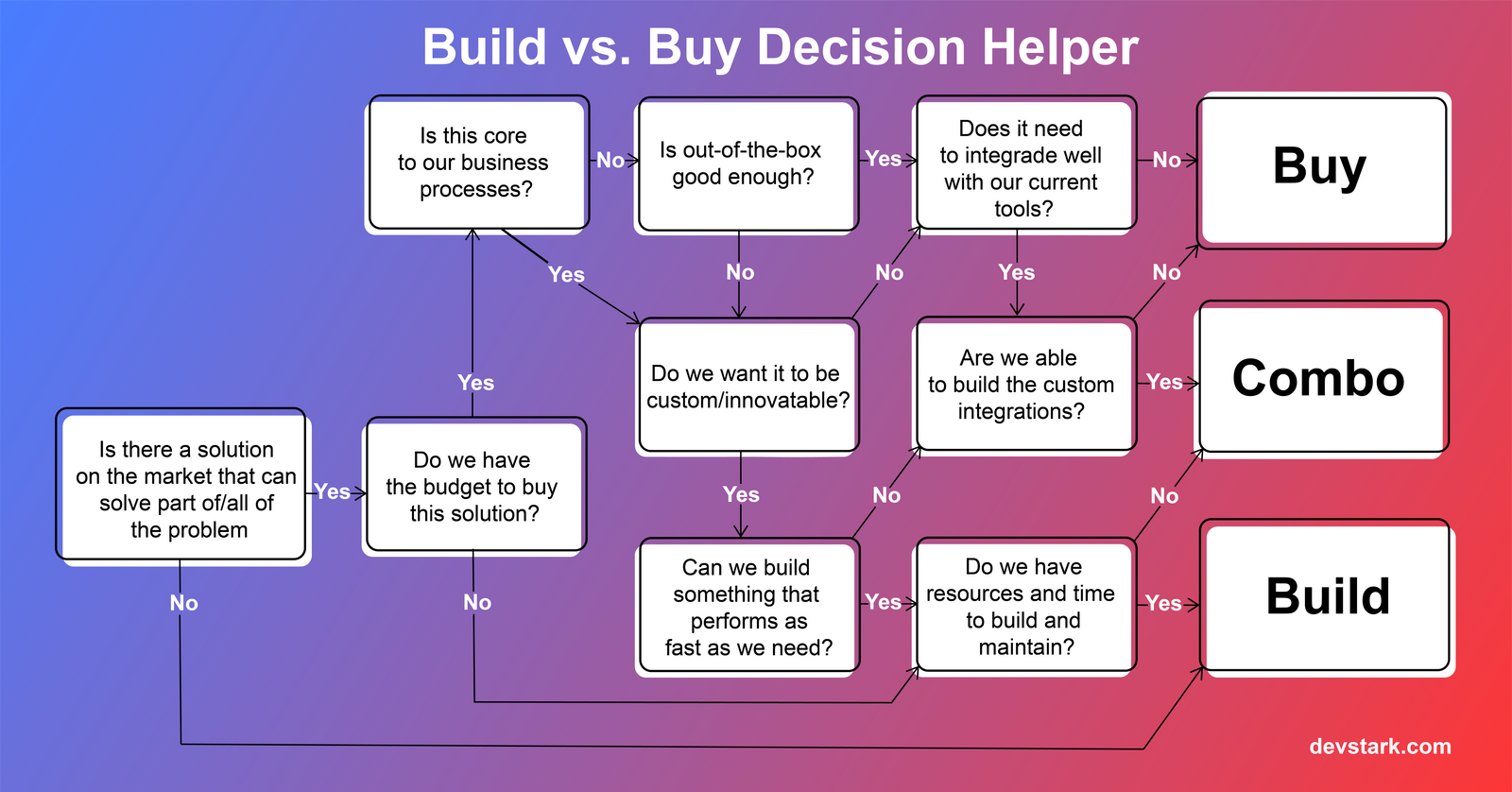
In most situations, it is not either build or buy but rather the right blend of both. This could mean developing the core custom part and integrating it with existing packaged software. Make sure that your decision is based on the objectives of your project as well as a fine balance between all these considerations.
Making a decision: A step-by-step decision-making framework
So how to make the important choice between developing the software, buying an already developed product, or perhaps combining both approaches in a rational way? The following approach could be useful in making the decision.
Step 1: Define the objectives of the project
First, it is necessary to define the objectives and needs of the project. What do you want to achieve with the help of the software? What are the minimum needs and ultimate objectives?
Step 2: Analyze the budget and resources available
It is important to consider your budget and other resources available for making the decision.
- Step 3: Consider the time constraints involved
Look at how much time you have available to complete your project. This will determine whether time-to-market is an important consideration.
- Step 4: Consider customization considerations
Consider how unique the requirements for your project are. Is there a lot of customization required, or can you work with off-the-shelf products?
- Step 5: Consider integration considerations
Consider the integration issues that may arise when implementing the software solution. They can impact your decision.
- Step 6: Consider security and compliance requirements
Look at what security and compliance considerations apply to your project. If you deal with sensitive information, this can be important.
- Step 7: Vendor support and updates research
Research the support and update possibilities offered by software vendors for pre-built solutions. This could be important in making your decision, should you opt for third-party support.
- Step 8: Evaluate hybrid solution possibilities
Do not confine yourself to only one approach. Consider hybrid solutions that combine the advantages of custom and pre-built products.
- Step 9: Cost-benefit analysis
Evaluate the pros and cons of both approaches (custom or pre-built product) regarding your specific project needs and determine which approach works best for you.
- Step 10: Consultation
Think about consulting with software development professionals who could give recommendations according to your specific project needs.
Suggestions for evaluating your project needs
There are many different perspectives which can help in making decisions about your particular project. Among these perspectives are end users, IT specialists, and management whose views are important to take into account when making decisions. By prioritizing requirements, you will be able to concentrate on what really matters when analyzing alternatives.
For complicated projects, it may be wise to try implementing a proof of concept in order to test your assumptions and make sure that you made a good choice. Along with testing assumptions, you need to evaluate possible risks related to your choice. These risks include budget overruns, project delays, and software security.
When choosing a solution, it is important to pay attention to its sustainability. Will this solution be suitable for you in the long run?
Additionally, try to think from the perspective of the end-user and consider how each decision will impact their efficiency. Be aware of any new developments in your field and staying abreast of industry trends can help steer you towards more innovative solutions.
It is important to keep in mind that the decision to build, buy, or use a combination of both is not a one-size-fits-all approach. Each case is different and requires consideration of the circumstances.
Key takeaways and considerations
Development of customized software is beneficial when you require tailored solutions whereas pre-packaged software is convenient in its deployment. Analyze how important it is for your business to choose one of these approaches based on the need for customization and fast deployment along with other factors such as costs related to maintenance and support.
Now proceed to the analysis of the deadline and schedule of your project to see whether it is urgent enough and find out whether the software you have chosen can be easily integrated with your current infrastructure and technology. Security issues are also important to be addressed since they will depend greatly on the requirements of your project especially if it deals with confidential information.
Pay attention to the support and updates offered by the software vendor as it can greatly influence your future maintenance. Do not hesitate to combine custom and pre-packaged solutions if necessary.
It is highly recommended that you consider all the special aspects of your project before making a decision. You need to take into account your objectives, financial possibilities, and other aspects related to the development of software. What works best for someone else may not be suitable for you. The key is to conduct a full-scale analysis, which will become your trump card in this case.
In case you need advice or professional help in software development, we suggest you turn to us. We are always ready to assist you in creating software applications and can offer a wide range of services. Please feel free to contact us whenever you have some questions.